

Interview
“AI is taking our jobs!” — The cry echoes relentlessly from leading news sites and magazines, a shout that can hardly be met with anything but a knot in the stomach. Because that’s what it is. Whether it is a call for help, a push toward action, or simply a misleading outcry — the coming years will decide.
But until then, what are we supposed to do?
Should we sit back with folded arms, or should we learn? What is the right decision? What should we study, and in which direction should we move? These are questions we all ask.
Those who read us know that we strive to approach topics positively, yet objectively. Sometimes we succeed more, sometimes less. We are human, shaped by our own experiences. But one thing is certain: ordinary women write here about ordinary problems. Because we believe this is the only authentic way to do it.
And so today, in the spirit of this principle, let us share the story of a nearly fifty-year-old woman who, by learning with AI — not AI itself, but with AI — pushed stereotypes aside, even as the labor market, clinging tightly to those same stereotypes, tried to push her aside.
And at the end of her story, everyone can decide for themselves whether the current state of the job market is truly the fault of AI.
I Will Defend AI!
I met today’s interviewee in a group dedicated to AI. Since she preferred not to reveal her identity, let us call her Anna. So I came across Anna through a post. The post presented an article discussing a recent Harvard study which found that women use generative artificial intelligence about 25 percent less than men, and even when they do use it, they often tend to value their work less because of it. The author also pointed out that early adopters of new technologies are rarely women. The person who shared the post was curious whether we agreed with the article.
Anna responded with an unequivocal opinion:
“I do not agree. AI gave me a job after six years of fruitless job searching. In my work I use three AI programs throughout the entire day. Without learning how to use AI, I still would not have a job. I had to complete tests for the position, and I was hired based on those results.”

So Anna spent six years searching for a job in vain. In the end, she managed to land a position with the help of AI. I knew I had to learn her story and bring it to you!
I reached out to Anna, who kindly agreed to share her experiences from the past few years with us.
The interview follows:
Because of my age, and also I am not exactly very attractive…
Tell us a bit about the previous fields you have worked in. What kind of work did you do, and what qualifications do you have?
I previously worked as a translator. I studied to become a Hungarian-Slovak language teacher, but I had been translating and interpreting for others since childhood. Being bilingual, it just came naturally. I am a Hungarian from Slovakia.
How old are you? When did you start actively looking for a job, which eventually lasted six years?
I am 49 years old. Around the age of 42, translation work started to disappear, so I began looking for other jobs, but because of my age, no one wanted to hire me, even though I had started learning English at 41 to improve my chances in the job market.
Since 2020, I’ve been called in for job interviews three times. In two of those cases, I wasn’t chosen because of my age and my physical condition – I would have been working as a bookstore clerk, climbing ladders to stock books and rushing up and down whenever the phone rang or a customer came in. By 2024, I more or less realized that, unless a miracle happened, I needed to learn something new, because I wasn’t physically tough enough for factory work, and my skills for office work were both insufficient and outdated. Besides, I wasn’t as attractive as I had been at 25… I had no idea what to study.
These are very important and difficult statements and hard experiences. Based on them, the triggering points that set you on your current path are quite clear. Was it because of these experiences, around that time, that you began turning toward AI?
At the beginning of 2024, I was still just drifting along when my husband, a programmer, showed me ChatGPT. Back then, it was still in its infancy and not very well known in the country (Hungary–Slovakia). I downloaded it, and somehow I got hooked. My husband even signed me up for an AI course, thinking that I might as well learn about it, just in case it would come in handy someday.
It later turned out that this gave me a one-year head start over everyone else who only discovered ChatGPT in 2025.
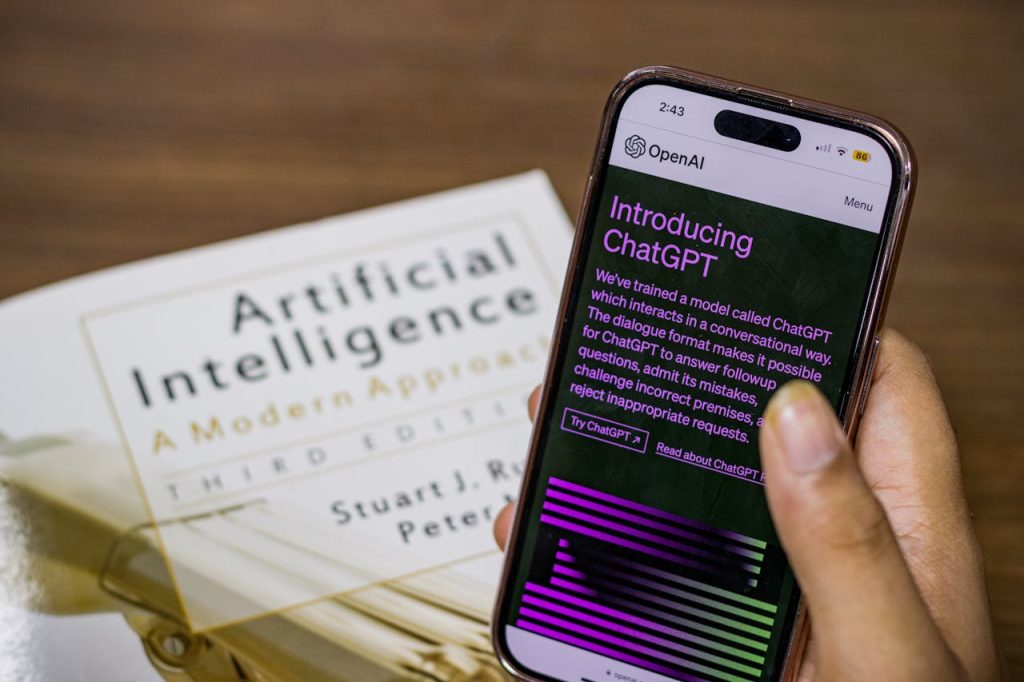
The course was aimed at IT professionals and provided a comprehensive overview of AI and how it works. Besides ChatGPT, we experimented with many image- and music-generating programs, such as MidJourney, Leonardo.ai, and Adobe Firefly. However, nothing changed in the job market for a whole year after the course. I kept using ChatGPT constantly, though, so I was able to follow its development—and, as we could see, it was evolving explosively, always capable of something new.
So it really was a comprehensive training in language models. And indeed, most people are still scrambling to keep up. I feel the key was speed and focused attention. You said that nothing changed at the time. What did you do after that? Did you continue learning in other areas?
In the summer of 2025, on a sudden impulse, I decided to try building a website in WordPress—even though I had zero experience in web development and had never even registered a domain. I created the basic website in just three hours, with ChatGPT guiding me through the entire process. My husband didn’t help at all—although he works in IT, he isn’t familiar with this area—he only received the link to the finished site.
After that, I started refining the website while learning what SEO is and how a site should be structured so that I could run Google ads on it. A friend showed my work to her husband, and he hired me part-time as a web designer. I built his company’s website, and by the time I finished, I had become a strong intermediate in this field. I learned how to use Elementor, apply CSS, work with HTML code, manage grids, handle responsive settings, and more—all with ChatGPT’s help, without anyone else assisting me. This is how I gained much more modern and relevant skills.

So you didn’t stop there?
Exactly. And it paid off. Sometime around early November 2025, I came across a job posting on Facebook. A multinational company was looking for people to localize their Hungarian webshop. They required native Hungarian, language skills (which I had), knowledge of SEO, and AI usage. After a long time, I applied with the calmness of someone who thought they had no chance.
A few days later, they called me to complete tests that required stylistic sense and AI skills. Then, on a beautiful Wednesday, they called again to tell me the job was mine. I couldn’t believe it.
Now, I work from home translating, editing, and publishing product descriptions online. No one cares about my age or appearance, and I decide how many hours I work and when. I usually work 47–48 hours a week, so even at 49, I’m fully capable of handling the job.
Based on this, your story is a success, but one shadowed by years of hardship. What would you say to those who are afraid, who might be in the same situation you were a few years ago? Or who simply don’t know which way to move forward amid all the loud noise around them?
AI won’t become self-aware, because it’s developed by programmers and doesn’t function without people.
It’s not AI that takes your job, it’s the people who learn how to use it, because they can work at multiple times the speed and handle workflows they don’t even fully understand. It’s true that some professions disappear because of it, but new ones are emerging and there’s room in them even for someone who’s 50, as long as you know how to reinvent yourself. If you don’t see it as an enemy, it can actually help you move forward. AI won’t become self-aware because it’s developed by programmers and doesn’t function without people.

Summary
So, after research showed that women often feel hesitant to use AI and that they rarely appear among the early adopters, here is Anna’s story as an example. By bypassing human expectations, she was able, with the help of a machine, to overcome stereotypes and the impossible but still socially enforced standards that say you should look and move like a 25-year-old at 45.
The article referenced before the interview, which framed our conversation, analyzed data from 2020 to 2024/2025. I can clearly see that the gap is narrowing and there are areas where women are actually leading in technology use.
For example, in the tech industry, 68 percent of women use generative AI tools multiple times per week at work, compared to 66 % of men, according to a Boston Consulting Group study. Additionally, women in senior technical roles lead their male colleagues by 12 to 16 % in AI adoption, according to Women in Tech Stats 2026.
So the picture is never black and white. We could compare women to men, but in reality, it is not optimal to measure ourselves against men or anyone else. Measure yourself against your yesterday self and strive to improve every day. Listen to Anna, because even if it seems like doors are closing, they might actually be opening.
